
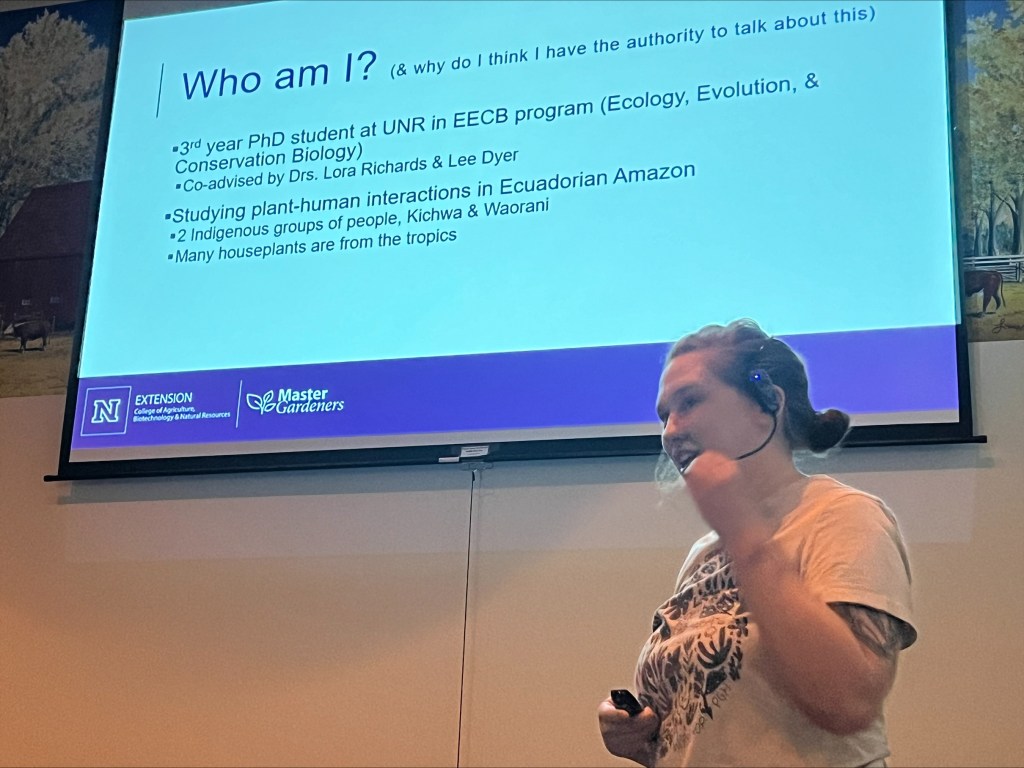
My role as an educator varies depending on my audience (Microbiology TA, Master Gardener, UNR MNH volunteer), but regardless of the age of my students or the content I am teaching, my biggest goal is to make my students feel safe and excited to learn, ask questions, and express themselves in my presence.
Technology’s Role in Education
Using technology to augment learning, not replace it.
Technology absolutely, unequivocally should be used in teaching; however, technology should enhance teaching practices, not replace them entirely. Hands-on experience is important and cannot be fully mimicked using online methods. Technology enables visualizations of things—ideas, places, processes—we cannot simply explain with a whiteboard or textbook. Moving visuals like narrated videos, GIFs, and virtual learning environments are essential in improving learning and teaching.
Using technology in teaching is very exciting to me. I find myself struggling to explain concepts in different ways when I run into a student that is having trouble understanding something. In my teaching context, technology helps me explain difficult topics so students can move quickly through their lab work. I currently use powerpoint during presentations while I TA. I also play music during lab to make the lab feel more relaxed and comfortable. The students submit lab reports via canvas/webcampus. I usually only add minor details to the slides for each lab, sometimes to make things more understandable. I want to amend the powerpoints more since I have been TA-ing the same class my entire time here, but have not found the time or motivation to spend on that when I have research I should be focusing on. I pull up diagrams on the internet as I need to explain things further, and should find and save those links so I can be consistent. My students are mostly undergraduate pre-nursing students, primarily women, and have varying background in lab work and microbiology. The main reason we use technology in the lab is to write two, 3-page lab reports per semester.
Technology & Accessibility
I want to incorporate more technology to engage and support diverse learners to help explain concepts that are not easily understood. Visuals aid both teacher and student in understanding the content of difficult labs; the teacher can allow the visual to communicate an idea to the class while speaking personally with a student or group of students. Since the lab is mostly hands-on or requires understanding from reading, videos and visuals can aid visual and auditory learners. Because the lab involves microbes, we are not allowed to bring phones or laptops out during class to aid in learning, so all technology must be provided by me via the overhead projector or links via email.
Accessibility (money, ability), previous exposure/experience in high school or at work, and relevance to their future goals are three barriers that may influence ability and desire to use technology. Most of my students have not had good exposure to microsoft software (Word, Powerpoint, etc.), and even struggle using Google docs etc. Most of my students have access to iPads and/or laptops and use Google software for writing and making presentations. I share free online products (e.g. Canva) for creating diagrams for their second lab report if they do not have Microsoft products, and refer students to the writing center for help with grammar and organization. The instructor for Microbiology at UNR does not allow the use of AI for assistance in any aspect of the course.
While I love utilizing technology—old and new—to enhance my abilities as a teacher, I do have concerns about the future of teaching (and learning) in a world that is increasingly integrating AI into everyday life.
AI is my main concern with technology’s role in education. When it is used poorly, it can result in lower grades because of differences in content that are not fixed before submission. It is also a short-cut akin to plagiarism in some contexts, and usually does not result in any actual learning; for this reason, academic integrity is a huge ethical concern. Challenges will be getting my students to give extra time to improve their use of technology. I hold office hours for both lab reports, and not all students stay behind to receive help and ask questions. Because accessibility is a problem, equity is an ethical concern regarding the use of technology in teaching.
AI—like all other technologies we use—has consequences across many sectors of our lives; its increasing integration introduces new problems not just in education, but in ecological, cultural, and societal spheres, as well. The introduction of new data centers, mainly on Indigenous lands or in already-crowded concrete cities, and the destruction of natural ecosystems to mine for the natural resources needed to construct these centers cannot and should not be ignored in the name of progress. The substitution of human-made art for that which is generated by AI, while convenient and accessible (i.e. free), robs artists of their personal works and their incomes.

